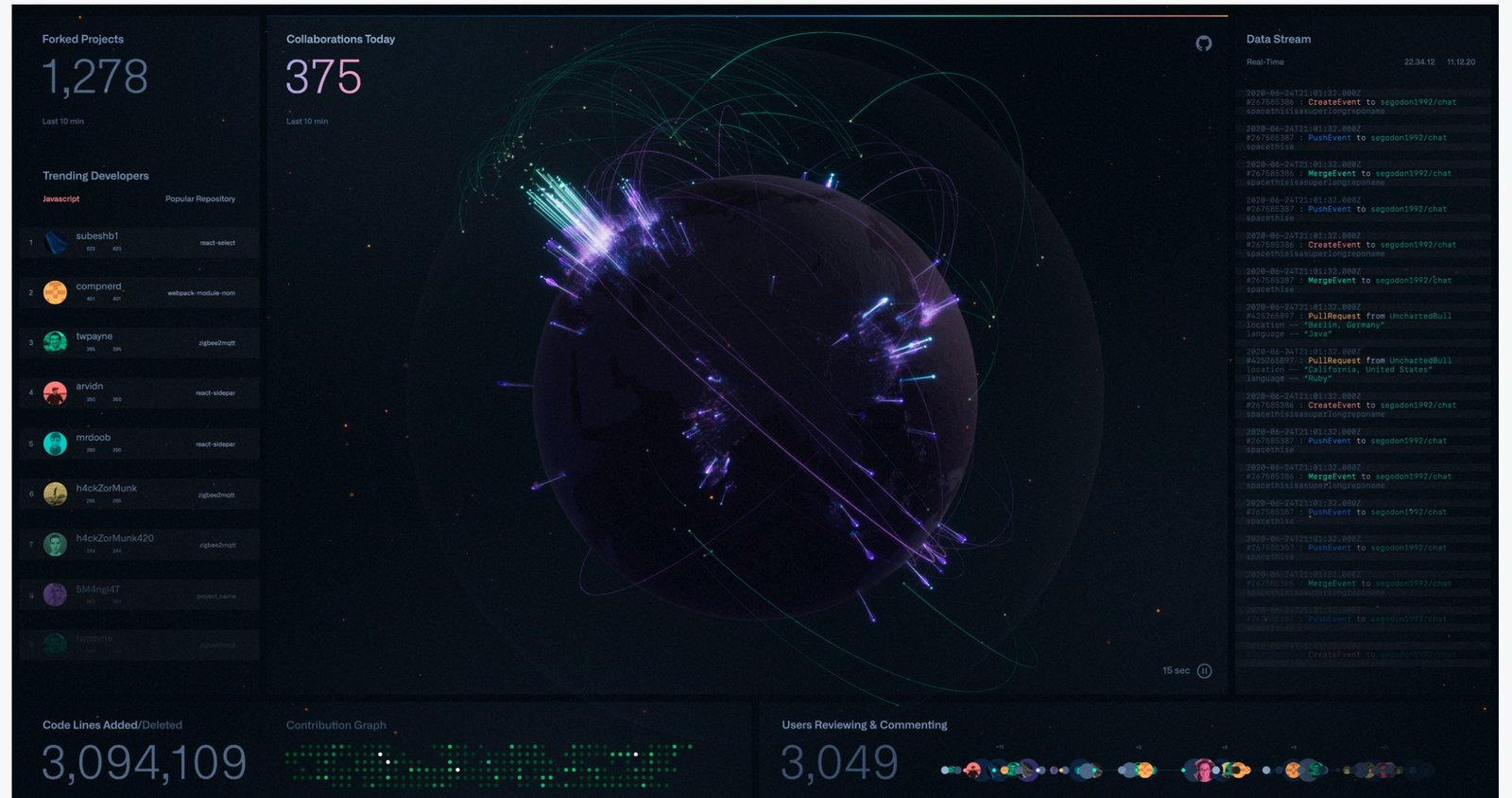
It's March 2024, and a developer named Brendan is standing in front of a wall of screens at GitHub's San Francisco headquarters. A globe turns. Lines of light arc between cities. Down one side runs a list of Trending Developers, and fourth on it is his own GitHub handle. He takes out his phone, zooms in on his name, and posts it: "look mum i'm at github hq."
That wall was my project. In 2020, I spent a year building something GitHub had never had: a live view of open source as it happens. A globe where you could watch pull requests travel between strangers, and see a heart appear whenever someone sponsored a developer to say thank you for their work. At GitHub we just called it the visualization. In my head, it was Mission Control for open source. The agency we hired named it Gitmos, and that's the name that stuck.
It didn't serve customers, had no place on the roadmap and had no engineers assigned to it. I led it anyway, from the first brief to the final install. I wrote the RFP, hired the creative team, built the data pipeline myself, and saw it installed in San Francisco and Redmond. But it started a year earlier, in Berlin, with Cerebro.
Where it started: Cerebro
As an AI engineer at GitHub, one of the things I did was spend time wandering the data lake. It taught me the shape of our data, and with it, the kinds of stories that data could tell. Then, on GitHub itself, I found an open source graph explorer that could map the communities inside GitHub's social graph, fed by the public GitHub Events API.
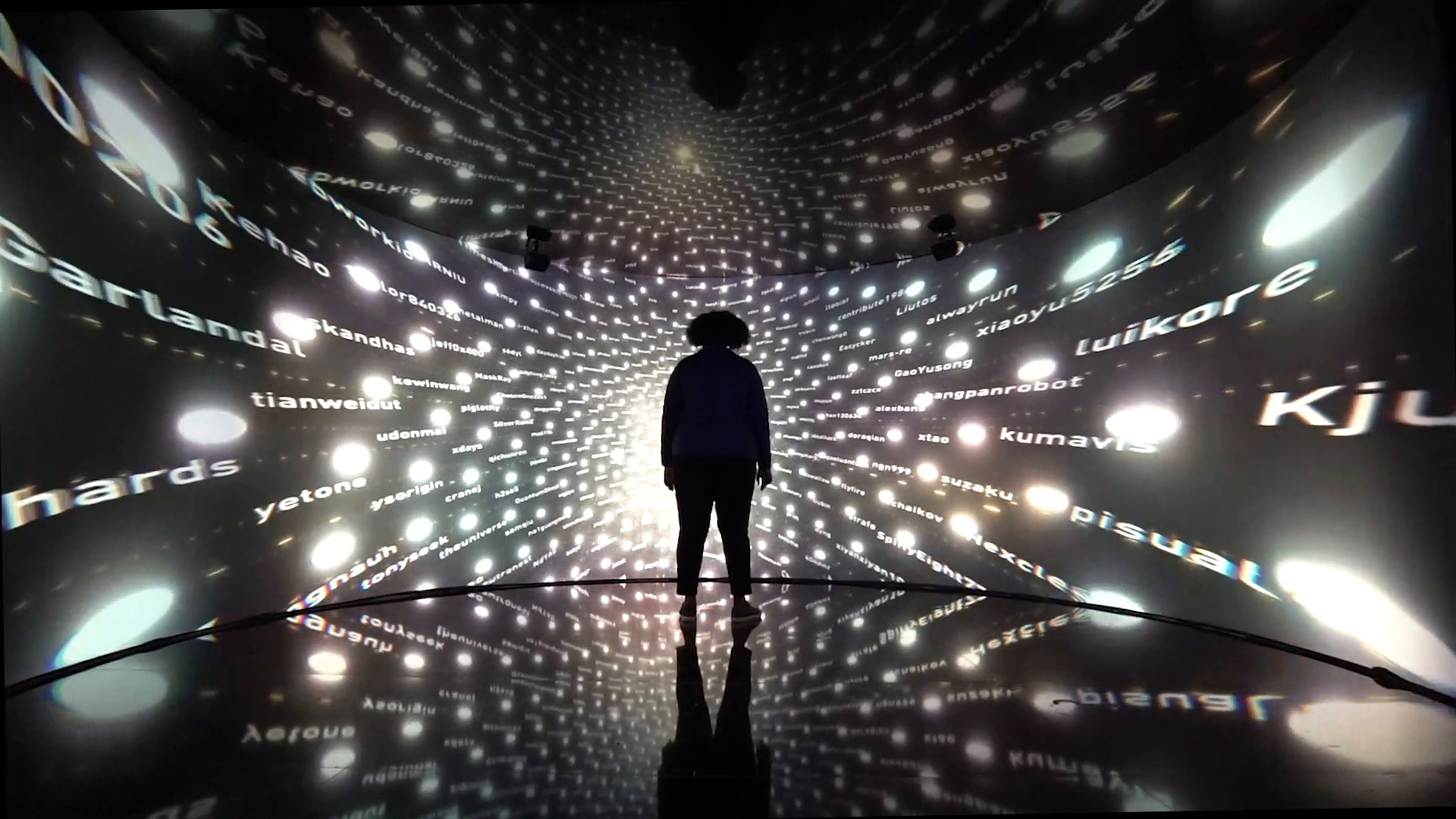
I had so much fun playing with it that I knew developers would too. So I pitched Cerebro, an installation for GitHub Satellite 2019, our developer conference in Berlin: a dome-like room wrapped in screens, with the graph all around you, the way a planetarium surrounds you with stars. You'd walk in, type your GitHub username, and find yourself among the developers clustered closest to you.
I got the green light, sorted out the tech, and built it with the events team. In Berlin, it was a hit. Nat Friedman, then GitHub's CEO, saw it and loved it.
A product with no roadmap
By 2020, I was Nat's technical advisor, and GitHub was building its first Executive Briefing Center. The question was how to tell the story of open source in a physical room. If GitHub is the home of open source, what does that look like? How do you bring work that exists only online into meatspace?
Nat's answer was a visualization, and as his technical advisor, it landed on my desk. By the usual rules, it should never have shipped. Products at GitHub exist to serve customers, and this one served none directly. So it had no place on the company roadmap and no engineering headcount. What it had was a budget, and me.
On March 9, 2020, I sent out an RFP. GitHub, I wrote, was "a global hive mind," and I wanted its visualization to be "badass and like a movie." My references were the screens in Iron Man, Minority Report, Tron and Oblivion. The best part of the whole project was reaching the people who had designed those film interfaces and asking: do you want to build one for real, with real data running through it?
I interviewed three firms, and each brought someone from those films. Territory Studio's design lead had been lead interface designer on Minority Report. Rally brought a motion designer who had worked on Jarvis for Iron Man 2. Tool of North America brought GMUNK, who designed the screens in Oblivion. I hired Tool, with GMUNK as director.
The story in the data
GitHub has a long habit of telling stories with data. Every year it publishes the State of the Octoverse. Gitmos took that tradition and imbued it with life. Instead of a yearly snapshot, it was the Octoverse in real time.
I wanted it to be optimistic, a techno-optimist picture of the world. My brief first made security the centerpiece, with Dependabot fixes rolling out across top open source projects. When we saw it on screen though, it fell flat, so I cut it.
The central story became the pull request. At its core, GitHub solves a coordination problem: people who may never meet, building something together. It can do that because the pull request makes the work legible. To tell that story of coordination at planetary scale, we projected those pull requests onto the globe. Each one became a line of light, drawn from the city where one developer opened it to the city where another closed it. In the brief, my example was a pull request opened in Caracas, Venezuela, and closed in Abuja, Nigeria. As you watch those lines arc across the globe, you're watching humans working together to accelerate human progress.
Open source breaks the usual rules of work. People build some of the world's most important software for free, around a shared purpose. It is the purest form of a mission-driven enterprise, and I wanted you to feel that when you looked at the wall.
I had felt it myself on a trip to Nigeria with the office of the CEO. We were in a café full of developers, and we could see them opening pull requests on open source projects. There was an instant spark of kinship, the recognition of someone from your own tribe. That moment bridged culture, ethnicity and country. It's one of the most beautiful side effects of technology at planetary scale: soft diplomacy.
The second story was funding the commons. GitHub had just launched Sponsors, so the community could support the people who build open source directly. A sponsorship isn't payment for a job. It's a thank you: I see you, I support you, and I want you to keep doing this work. The legal and regulatory work behind it was hard, but we got it done. On the globe, whenever someone sponsored a developer, a heart appeared at that developer's location.
Sound mattered too. Keith Ruggiero, the team's composer, wrote binaural beats to go with the visuals, so the whole thing was immersive. And I never wanted it to be only for the few who made it to GitHub HQ. From the first brief, it was meant to run on the web as well as on office walls, so any developer could have it on a screen at home.
Building it
With no headcount, the AI engineer became the data engineer. GitHub's ecosystem team had already built open APIs that reported what was happening across repositories, but they didn't give us everything the wall needed. So I went into GitHub's codebase, a Ruby monorepo, and extended them until they did. Ricardo Cabello (Mr.doob), the creator of three.js, worked on it at the beginning, before we decided to build in Unity. Wim Vanhenden was with it throughout.
We built it during COVID. Supply chains stalled, and the screens didn't arrive on time. We were installing in two places, San Francisco and Redmond, Washington, and each site had its own procurement process. A lot of the work no one sees was operations and paperwork. On Tool's side, that work ran through Adam Baskin, the executive producer, who kept the whole thing moving.
Taste
I started in April 2020. By December, the first version was ready, and I was excited to ship it.
Nat said no. It wasn't ready, he told me. Go back to the drawing board.
So I did. Throwing it out felt like losing months of work, but it was the right call.
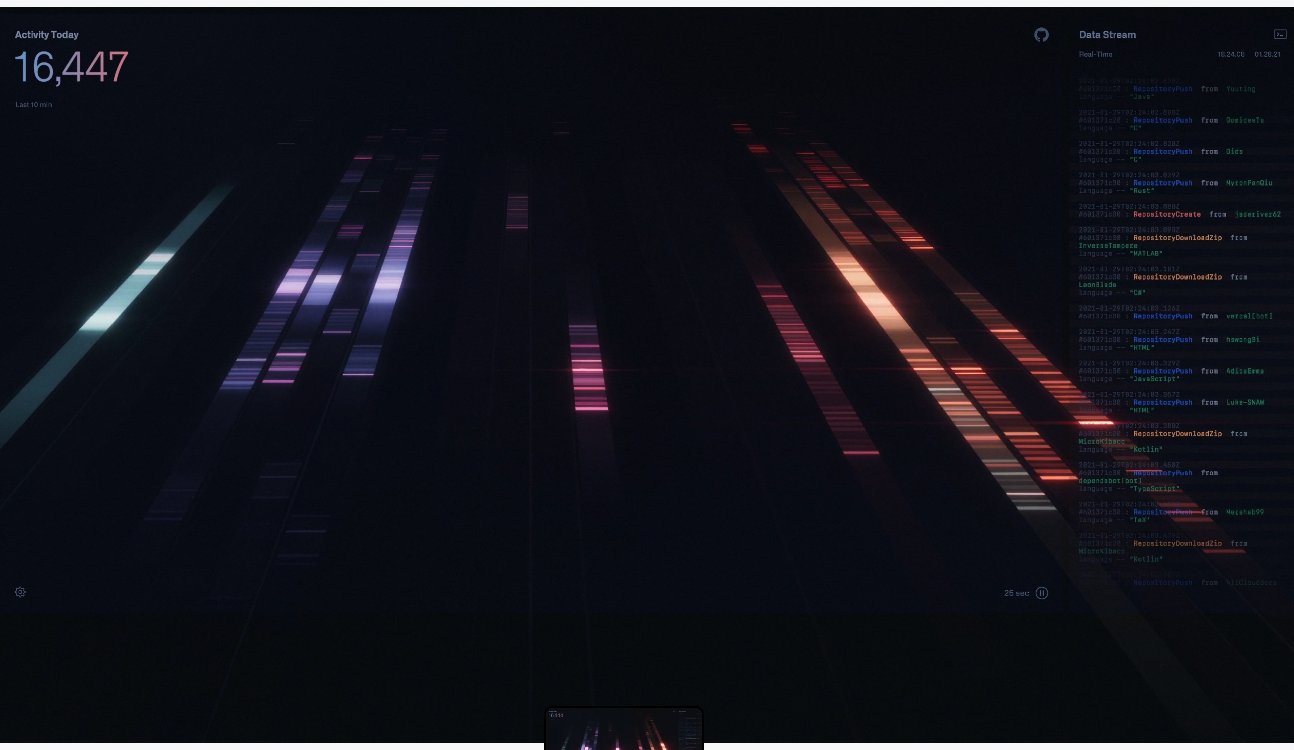
Looking back at the first version, I can see what Nat saw. The security story was still in it, Dependabot fixes rolling across the screen, and it wasn't beautiful. You couldn't even tell what was happening. We didn't trim it. We cut it all the way out. There was no music yet. And the whole thing was built for the web, which is where I'd always wanted it to live, but on a wall of screens it didn't pop. So for the second version we moved to Unity and let the technology serve the room. Keith's music went in. We added the global counters, lines of code added and lines removed each day, because in open source the deleting matters as much as the adding.
And down the right edge, the live stream of events. In the first version it was there, but when you pressed play the numbers jumped, and at full speed it moved too fast to read. Making it real, pull requests and pushes with sub-second finality, was some of the hardest engineering in the project, and the hard part wasn't speed. It was the opposite. We had to work out how to sample it so a person standing at the wall could actually follow it.
The next version was far better, and this time I could see why.
Part of what made the bar so high was the brand. The hardest thing about this project wasn't the technology. It was reverence. The Octocat means so much to so many developers, and a GitHub hoodie with your username on the arm is a status symbol, one of one. Whatever we put on that wall had to be worthy of that.
What I took from it: find people whose product taste is better than yours, work close enough to them that it raises your own, and then hold yourself to that standard.
After launch
The new version launched in 2021. Next, I wanted to bring it into developers' homes as a cloud-streamed app, so anyone could keep it on a second screen. I left GitHub shortly after launch, so I never built it.
People found it anyway. In March 2024, a nine-second clip of the wall passed a million views on X, captioned "Every time you push code, you appear on this real-time wall at the @github HQ." The same clip, reposted the next day with "every company should have a real time stats dashboard like github's," drew another 716,000 views and a reply from Elon Musk: "Yeah, this is cool. X should of this too." Nat replied under the original: "This was very fun project we did with @omojumiller." Others asked for exactly what I'd planned to build next: "Can't you guys make a public version?"
This was very fun project we did with @omojumiller
— Nat Friedman (@natfriedman) March 27, 2024
Yeah, this is cool. X should of this too.
— Elon Musk (@elonmusk) March 28, 2024
Brendan wasn't the only one who found himself on it. "Pretty cool to see yourself randomly pop up on github's internal dashboard of trending developers," another developer wrote.
It keeps coming back: in January, June and July 2024, and twice more in October 2026, when a visitor at an open source AI meetup at GitHub HQ asked, "Have you ever caught your commits live on the big screen?" At the San Francisco office, which hosts a lot of open source meetups, it has become a point of pride. Developers stand in front of it, take pictures, and get lost in it. There's a shared sense of ownership in that, a feeling of "this is why I work on open source." It's being recognized. It's being seen.
Not everyone was a fan. When it showed up on Reddit's r/selfhosted as "The Ultimate Dashboard?", one commenter called it "corporate wall art." That's fair. Gitmos was built for an Executive Briefing Center. Its job was to show visitors the power of the platform at a glance, not to help anyone make a decision. It is corporate wall art, made from live data about real people's work. As another commenter put it, "The goal is vibes."
Who owns this work
Projects like this are hard because they cut across teams: marketing, data engineering, the office of the COO, workplace. This one also cut across the seam of an acquisition. Microsoft had bought GitHub in 2018 and, deliberately, left it to run as itself. So we were one company with two headquarters, San Francisco and Redmond, and two of everything underneath, down to procurement. I'd seen that before. My PhD at Berkeley was in computer science education, which meant it belonged to neither the computer science department nor the school of education, and was granted by the graduate division instead. Interdisciplinary work matters, and it is a pain in the ass.
It's hard because nothing is designed for it. Companies are built from silos, universities from departments, and work that falls between them has no owner. So it gets done by workarounds, and workarounds depend on unusual people who are willing to carry something that belongs to no one. This is a bug, not a feature, and bugs should not be tolerated. We need to design systems where work can cross the silos, instead of depending on the people who do it anyway.
GitHub was one of the rare companies that did. Gitmos was corporate wall art, built to impress visitors in a briefing center. It was also a portrait of the commons: people who may never meet, building something together, mostly for free. Both were true, because GitHub was both, and it was built in that order. It started as a home for people using Git to work on open source. Enterprises came later, and only because they asked. Most startups go enterprise first and community second. GitHub was the reverse, and it stayed that way, a for-profit business and the home of open source, with neither sacrificed for the other. The tension between them was the point.
The executives were the audience. The people on the wall were the reason. The developers I watched in that café in Nigeria, opening pull requests to strangers. Brendan, finding his name at number four. Anyone who has ever pushed code into the commons and wondered if anyone was out there.
Gitmos had no owner inside GitHub, and the thing it showed has no owner at all. That's what makes it worth protecting, and it's why the question underneath this essay is still open: who funds the commons? It needs to stay independent, funded by all, for all. I don't know whether something like Gitmos could be built today, or what it would show now. Models, languages, skills? But the reason to build it hasn't changed. Humans working together to accelerate human progress deserve to be seen.